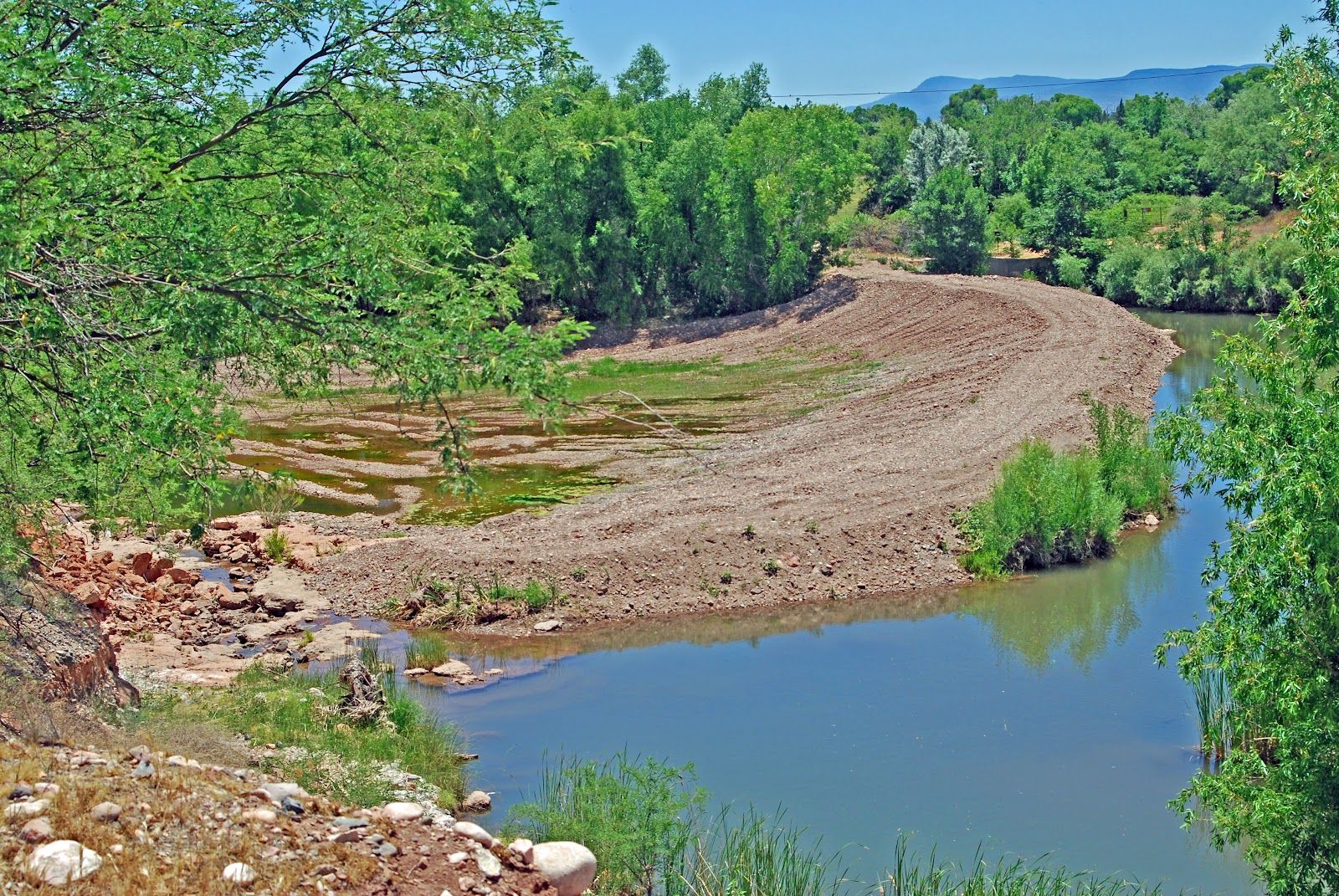
Showing posts with label rivers. Show all posts

Wednesday, August 22, 2012

Where Water Meets Sun

This photo of a remarkable project in India was recently sent to me by Richard M. Hileman, a Facebook friend who obtained it from Occupy Wall St. It came with his comment, "This would be good for Arizona."

This solar panel laid on the vast stretches of agricultural channels 
in Gujarat India generates 1 Megawatt of electricity per km and 
prevents evaporation of 1 crore (10,000,000) liters of water 
every year.

While it might prove impractical for the mountainous regions of northern Arizona, it would seem a workable solution for clean power generation and water distribution in the southern part of the state which has higher proportion of largely flat land.


The concept would particularly suit irrigation projects and diversion canals which are already level and suffer high levels of water loss due to evaporation.

Monday, June 25, 2012

Has the Aquifer Run Dry?

In a recent news note in the VerdeNews.com, Tom Whitmer of Cottonwood, Arizona, had been nominated for a position on the Technical Advisory Committee with the Yavapai County Water Advisory Committee.

Photos taken from verdenews.com
His nomination was questioned by Doug Von Gaussig because Mr. Whitmer serves on the board of that organization and the conflict of interest was all too apparent . . . especially with respect to an appointee who would, in effect, report to himself.


I congratulate Mr Von Gaussig whose foresight has otherwise addressed many of his communities difficult problems.


I would like to see either principal in this local scuffle, begin to answer Jerome, Arizona's, water difficulties.
  
Here in this ex-mining, tourist town we drink from an aquifer via a couple of large storage tanks.  But the overflow from these tanks has stopped...which means that 1.) the tanks aren't full or 2.) the aquifer has stopped charging the tanks. 


We've had little rain, the Verde River is at record lows and a Jerome town council member is talking about the installation of water meters.  What if there just ain't any water?

Saturday, March 17, 2012

Which Will Win. . . Water or Uranium


You just know it will be uranium because it's worth more...

"Washington’s decision to bar new uranium mining near the Grand Canyon and other federal policies on energy and resource issues," says the Casa Grande Dispatch, "are barriers holding back Arizona and its residents from prosperity," Gov. Jan Brewer told a congressional hearing Friday.

"Further", the Republican governor said, "the January decision by the Obama administration to block new uranium mining near the national park deprives a rural area of needed jobs and ignores that there are safeguards that would protect the environment. She also criticized federal policies and regulatory actions involving forest management and power plant emissions."
"Unlike in decades past when the federal government and the state partnered on dam and aqueduct projects, use of natural resources is at risk due to red tape and overregulation from Washington, Brewer said."

“We all love Arizona. We all treasure the Grand Canyon. We all support clean water and clear skies,” Brewer said. “But Westerners need a federal government that will work with us to achieve our shared goals of a strong economy and a sound environment.”

"Interior Secretary Ken Salazar announced the 20-year prohibition that covers more than 1 million acres rich in high-grade uranium ore reserves in the region of the Grand Canyon. Uranium is used in nuclear power plants."

"Salazar said he took the action to protect the Grand Canyon, which he called a natural treasure."


Clever...if she had said "Stop the mining",  her reason would have been the natural requirements of the Grand Canyon...had she said, "Go for the water...," her excuse would have been jobs.  


Gov. Brewer ought to swallow her tongue and make up her mind.

Sunday, March 11, 2012

A Canary in the Mine

Not a drop of water that can be imagined.  Not even a trickle of a seasonal or intermittent  stream that might provide water.  Y'know, the kind on topo maps that are designated with dashed blue lines.
Water in Arizona is scarce, often a matter of life or death. 
However, we read this.... 
"Ohio will soon be in the business of selling water to industry throughout shale-gas regions," a blogger claims.  Speaking of native amphibians of the Ohio River watershed, this blogger continues with the thought, "let's not forget who resides in that water."
"Amphibians are the canaries in the aquatic 'coal-mines.'  Their health should be important to us, as they are bio indicators for our future.  We should all be thinking about this a little more," she continues.
If the supply of water in the Ohio River is being questioned because mining operations require water, what solution do we have in Arizona where mining companies are tapping underground aquifers?  Just a thought . . . . .


Tuesday, August 30, 2011

Selling the Verde River, Part 2

It seems that any thoughts expressed about the Arizona ditch system that draws water from the Verde River generates a variety of knee-jerk reactions that are inaccurate or irrelevant.

The point made in the previous post was that the design of the diversion dam on the Verde River may be pushing more water through the Cottonwood Ditch than it is entitled to take.

I did not (1.) condemn the ditch system nor did I (2.) disparage the 300+ users of Cottonwood Ditch water.  Although certainly possible, I did not (3.) question the environmental impact of the diversion dam.
Google Earth Image taken June 13, 2011, showing the Cottonwood Ditch Assoc. diversion dam.  Nearly 100% of the Verde River is blocked, diverting most of the river’s flow not along its natural course but to the Cottonwood Ditch. Various springs and seeps restore the river’s flow about 1,000 yds. downstream.

Others have concerns, as well. 
Doug Van Gausig, Mayor of Clarkdale, entered comments into the minutes of the town council meeting of June 2007 regarding Mr. Grosetas activity.

"This summer the Cottonwood Ditch is again diverting 100% of the Verde River into their ditch, allowing only a trickle to bypass the diversion. This is a terrible thing for the river's habitat. It means that the river is no longer a viable corridor for transportation and migration of aquatic animals - the diversion becomes, in essence, an unnatural barrier to movements in the river. I talked to Greg Kornrumph, of SRP, and to Max Castillo and Les Bovee of State Parks (which operates the Hickey Ditch) about possible remedies for this situation. I'll continue to work on this issue with State Parks, FreeportMcMoRan and Cottonwood Ditch to find an equitable, legal and durable solution to this annual problem."

A suggestion made by Mr. Groseta is that “interested citizens and political leaders consider the adverse impact . . . trees and vegetation are causing to our river system. These millions of trees are sucking the river dry!", he asserts. 

If this is the case, it’s surprising he has let trees and vegetation line the first mile or so of the Cottonwood Ditch.  (He is President, remember!!!)

As the photo indicates, the river's water has disappeared because of the dam, not because of surrounding trees and vegetation.

Mr. Groseta's myopia may stem from all the trees that block his view of the forest.

The question should not be my qualifications but Andy Groseta's take from the river.  It affects everyone.


NOTES: 
1. I debated whether to continue the subject of this blog in the Verde Independent.  A newspaper is not the format for on-going discussions of a subject.

2. Some respondents to my previous blog should learn the difference between insinuation and inference.  I don't insinuate anything, but I can't control reader inferences.


Tuesday, August 2, 2011

How to Sell the Verde River.

Andy Groseta has again blocked the complete flow of the Verde River.  He's entitled to do it...Arizona law says so.  The law also says he is entitled to take 10.6 cubic-feet-per-second from the river for the Cottonwood Ditch Association, an organization he heads up.
Note the increased level of the Verde River upstream from the dam and note
the curved configuration. That's important because it increases the flow rate of
water through the sluice gate that is a primitive way of measuring his
"take" ...which he sells.
His water-take is determined by a simple sluice gate.  The flow through that sluice gate, however, is determined by the pressure of the river, whether the river is "high" or "low".

Note the level of the Verde behind the dam.  It's 8 -10 feet higher than downstream.

The primitive measuring systems in use do not calculate river back-up, water pressure and subsequent flow.  

It's not the diversion dam that's at issue.  The issue is whether the design of the diversion dam increases his "take" beyond his entitlement.


Has anyone measured Groseta’s take from the river?

My neighbor has a sign that proclaims, “The River Always Wins.”

We’ll see.  The Verde may need some $$$s of its own.

Saturday, April 16, 2011

Water Resources and City Economics

The growing risk of water shortages in the Verde Valley and throughout the state of Arizona will have a direct effect on the bond ratings of the cities involved, says an opinion piece in the October 20, 2010, New York Times

Snowmelt is regional  and usually doesn't reach the broader environment
While lowered bond ratings are not currently a problem for many communities in this area, it likely could be in the future.

Part of this liability is due to local squabbling for this resource, commonly referred to as “water wars”, and the attendant legal costs that drain municipal budgets.

“Municipal bonds are bought and sold on the basis of their credit ratings,” the NY Times article reminds us, “yet today these ratings take little account of utilities’ vulnerability to increased water competition.”

Pursuing a cautious perspective against future water costs, the city of Cottonwood bought several water companies in surrounding areas and shortly thereafter raised the rates.  In an editorial of August 22, 2010, the Verde Independent characterized this buying as a “spending spree” and suggested the city follow the advice of its financial director, Rudy Rodriguez, to go on a PR offensive “so people understand why the attendant rate hike is necessary and important.”

The Verde Independent is correct that the city should communicate its intentions to its residents.  It's just good politics to tell taxpayers how the city is spending its/their money...and why. 

Rates, by the way, were decreased at the lowest use levels but, none-the-less, raised at higher levels.
There was a river but vegetation didn't know it.
It seems reasonable to give breaks to “minimal” users and raise rates for large users.  In other words, conservative water users will be charged the same or less than before the rate increase and “excessive” users would be charged at increased rates.

What is essential is that people realize we are living in the desert where water is scarce and finding a path to sustainable use can be complex. . .water is a limited commodity and should be expensive. 

Cottonwood officials realized that water use will be governed by our wallets and it was a far-sighted city administration that intelligently planned for the city’s future.

Of course, the saga of Cottonwood-water has a negative side.  According to a local resident the city is again planning to alter its rates upward because decreased water use has put a dent in anticipated revenue.  
Cliffs, Mesas, Water.

But, the Arizona Republic has another take.  In an April 15, 2011 article focusing on Phoenix, the newspaper wrote, "Residents Should Know Who Is Behind Water-Rate Hikes".  The paper claims the projected increase is due to the State of Arizona withdrawing $7 million in funding from the Arizona Dept. of Water Resources and shifting the burden to cities. The AR pins blame on Gov. Jan Brewer.

In either case the Arizona Republic echoes the Verde Independent in calling for better communication between city administrations and their residents. 

The likelihood is residents won’t like what they hear.  Water is going to be expensive…very expensive. . .and it should be because water in the desert is a scarce commodity. 

Thursday, July 15, 2010

If You Make a Mistake, You Die.

Currently 3 men from Salt Lake City are missing in the Superstition Mountains east of Phoenix.  They went to this Wilderness Area to find the Lost Dutchman Goldmine, an enduring legend that has claimed at least 40 - 50 lives.
A green water hole within a few miles of hikers


Fools gold, fools to the end.
They ventured into this environment with no resources...no water, no knowledge of the desert, no imagination.  
Water is available throughout the Superstitions.  Springs are numerous and you can spot them from the light green shrubs and trees that surround them.  Some say they can smell it.  If the men die of thirst with the lights of Phoenix glowing on the horizon, I'm sure there is an old expression that applies to their foolishness.
I've hiked every trail in the Superstitions, often when temps are 110+, and a good part of the fun is the implicit challenge that, if you make a mistake, you die.
That was for fun, the challenge.
If you die for a vaporous legend of gold, shame.  Unfortunately, the men are past reproduction age and their genes have likely been passed along.
Much of my caution in the desert comes from the realization that thirst is maybe one of the worst ways to die.
I should go there soon, for the nostalgia, the thrill, for the knowledge that it's a risk activity. . . to get my soul back.

Sunday, May 23, 2010

Arizona Boggles on River Definition…Ownership

I carefully tore out Steve Ayers’ article, “Verde ownership status still on hold”, from a recent issue of the Verde Independent  and have read and re-read the piece a dozen times or more.


Attorneys are the only ones who seemingly understand the questions of ownership of the Verde River and courts keep passing the issue up, down, and sideways.

The basic question, courts are asking, is whether the Verde River was “navigable” in 1912 when Arizona became a state.

Navigable is the operative word.

The impact of the answer is two-pronged.
  1. If navigable, the State owns the Verde River and it is public.
  2. If it wasn’t navigable, adjacent property owners own the Verde and it is private.
Questions are legion.

Does Arizona legally define rivers as having to be “navigable”?

What is “navigable”…?
      Navigable to an inner tube?
      Navigable to a river boat drawing 1 – 2 ft. of water?
      Navigable to an inflatable raft?
      Navigable to a swimmer?

What is in the best interest of the State?

What is in the best interest of the people of Arizona?

Is it in the best interest of the State to let ownership fall to property owners of the region who would “own” the water and divert it to a ditch system to sell to various interests?

Whatever the questions…Whatever the speculations…The river will win.  Attach sufficient legal handles, manipulate it through the courts, “handle” it enough, and…it will fool you. 

Rivers can be fickle.  Maybe…just maybe, it will dry up and call itself a dry wash.  

Saturday, May 8, 2010

Water Use Comes Down to Money


The ultimate solution to water problems in Arizona will relate to money.  For example, charges for water in any dwelling, at least in Jerome, AZ, is charged according to the number of residents.

Use is not metered and – lacking meters –per person is the only practical method.  (Rumor has it that meters were purchased but subsequently stolen for their brass content – ironic in a billion-dollar copper camp.)

Water use is apparently governed only by pipe circumference and pressure, averages and the guesses of city administrators of what each of us will use to shower, shave, flush toilets, etc.

The question begs, “Can we conserve?” Of course.  The ways and means are obvious.

But, where’s the benefit?  If I conserve water, who cares?. . .My water bill won’t change.

While Jerome is irrelevant to the wider concerns of water use in Arizona, the problem persists for the majority of the state.

The Arizona Department of Water Resources (ADWR) struggles along without budget or teeth.  People still refer to “sustained safe use”, the state still seeks development and, realistically, there isn’t a developer with a buck and a dream who can’t demonstrate the probability of a 100-year’s sustainable supply.   

Without minimal charges for essential, personal use and rapidly escalating ones for discretionary use, a luxury tax if you will, sustainable water use will remain elusive.

Friday, August 21, 2009

When the River Becomes a Swamp -- Part 2


Idyllic, isn't it?


The Verde River is high...ducks, blue herons, kingfishers and other wildlife "use" its braided path all the way to the Salt River far to the South.  

People. . . also. . .use the river and that's where trouble begins. Some use it for pleasure, others for commerce.  Some more wisely than others.

One of the more perceptive observers is Doug Von Gausig, the mayor of Clarkdale, Arizona.  Maybe a birder, he's certainly observant. Von Gausig has seen 175 species of birds on his property in the 7 years he’s been here.

Talking to "High Country News" in 2007, Von Gausig said, "...the Verde is more than bird habitat. The river is a touchstone for people who live near it...a place to spend time in, something beautiful, something that brings peace to their lives. (High Country News, "Battle for the Verde", May 14, 2007).


Today that sentiment may no longer be viable.  The river has changed.


Writing in the August 2009 Issue of The Noise, a monthly entertainment tabloid published in northern Arizona, Ellen Jo Roberts laments her aborted rafting trip on the Verde: "It's not an easy river"..."We never made it to (our destination)"..."Our plan was foiled by one portage too many...leaving us all sliced up with green reeds and weeds as sharp as paper cuts."


She explains, "...the river wasn't moving much...to get anywhere we had to vigorously kick...or risk circling in the same spot all day."


Although it likely wasn't within the article's scope, she fails to pose a simple question, "Why...?, Why doesn't  the river flow?"  That's what rivers do.


The answer lies with commercial interests and the fact that no consideration of the Verde River is complete without mention of diversion dams and the dams' affect on the environmental qualities of the river.


Questions are easy...solutions are complex and tangled in antiquated Arizona water laws.


Let's try the easy way . . .
  • Diversion dams serve agricultural interests.  With limited supplies of water in Arizona, why are some land owners determined to grow what the environment won't support naturally?
  • If commercial interests are at stake, what ethic permits these interests to take primacy over personal enjoyment?
  • If water ownership is primal, does that owner have the right to take water until the very river is destroyed?
  • Do water rights effectively mean river ownership?
High above the Verde River are the remains of the Anasazi dwelling, Tuzigoot.  Inhabited from about 1125 - 1400 AD, these ancients knew enough, even with water control structures of their own, not to destroy the river.  


Friday, August 3, 2007

Water Use Will Change...Like It or Not


Some people just don’t get it!

They seem to believe that water originates at the tap and hold the limited view that, since grass has been planted, it's a great idea to water it.

Or, if a hot-tub is available, it's quite OK to fill it...constantly...letting the tub's overflow drain handle the excess.

I have some otherwise intelligent neighbors who dismiss talk of water shortages in this arid region with the reminder that “our water comes from a spring and, anyway, the town charges families equally, whether we use it or not.”

Fortunately, this will change.

The Town of Jerome is in the process of installing water meters that will enable it to bill residents on usage.

A note on the Jerome Post Office bulletin board (it’s a small town, you know) proclaims that “Grapes are ripe at Xxxxx's. Come grab a bunch.”

Xxxxx waters his grapes twice a day with no thought of depleting the aquifer that supplies his preoccupation. We'll see if a few grapes are worth the high water bills. Realistically, however, if water from this spring doesn't flow into a storage tank, it runs down Mingus Mountain into Bitter Creek and ultimately into the Verde River.

The poor Verde -- It needs all the input it can get. As a newbie out here I was truly appalled at the diversionary dams that channel thousands of gallons-per-hour through open ditches. Signs posted by the Cottonwood Ditch Assn. proclaim, "NO Trespassing." (The photo that heads this blog was taken past this sign.)

The Northeast is experiencing the same poor water management. My friend, a competitive paddler, is lamenting the destruction of his training environment -- Akron, Ohio’s, East Branch Reservoir.

East or West, it’s all the same. Reservoirs, established by dammed rivers, are not an efficient place to store water. Aquifers, also, disappear with over-use and poor water management.

Powered by ScribeFire.