Showing posts with label mining. Show all posts

Monday, October 28, 2013

New Mine Waste Coming to Jerome, Arizona

The history of mining in Jerome Arizona has a checkered past.  Millions of dollars were earned by the mining companies and some of the towns (at least in Arizona) received a public building or two.  But the destruction of people and the environment carried a horrible toll.  
An open pit with a head frame half hidden behind shrubbery.
 Head frames were used to lower and raise miners from the
 88 miles of below-ground tunnels.
Myths, legends and a few factual stories have survived about the brothels, legendary madams, some of the saloons and epic fist and gun fights.  What is never questioned is why nothing has grown for sixty years on these piles of waste.

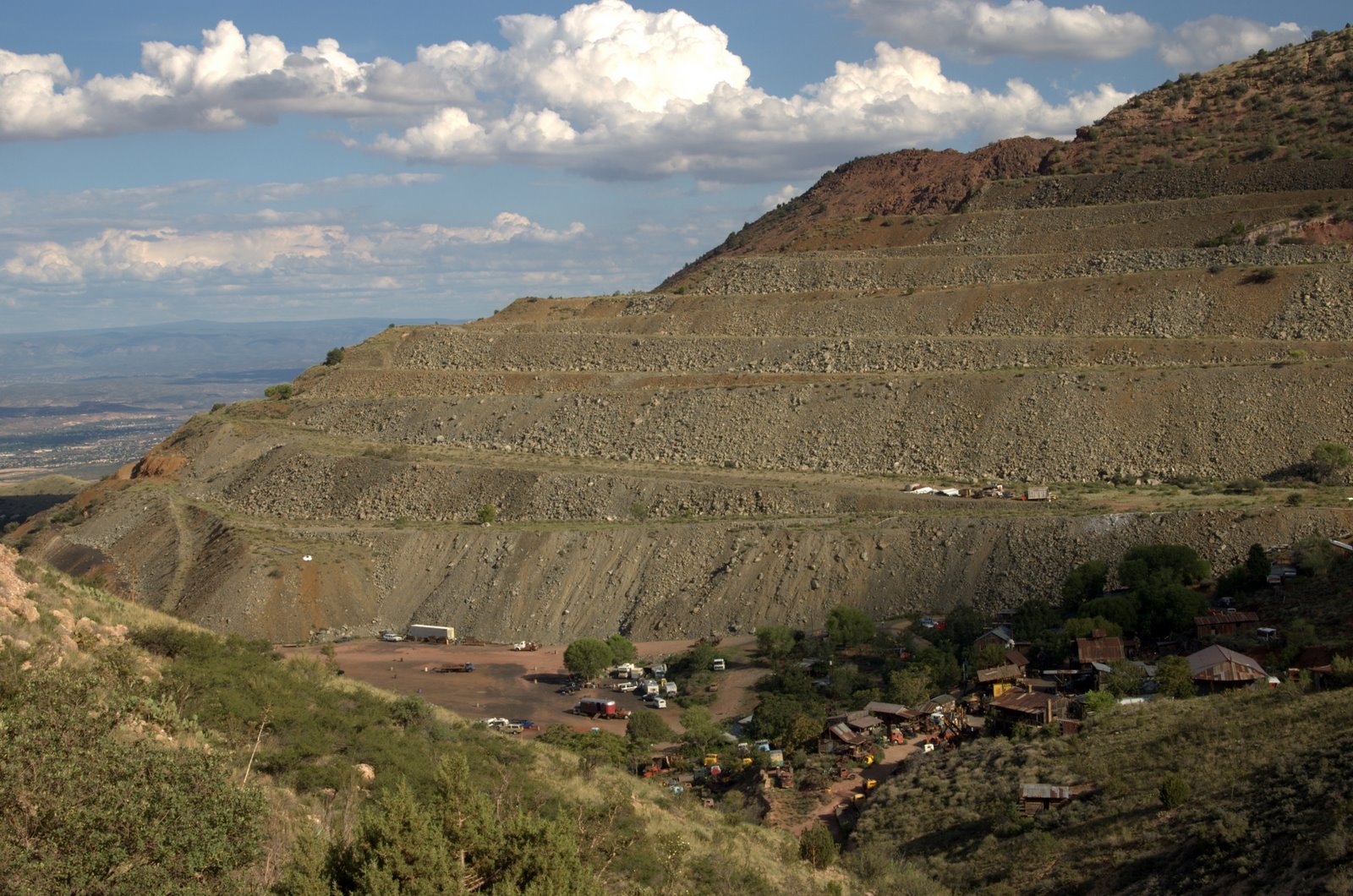
Mines in Jerome ceased operation in 1953.  The scale of these
 waste "layers" can be determined by the apparent size of
the 2-story houses at the lower right of the photograph above.
Despite airborne pollution (toxic dust) and ground water toxicity due to 60 years of rainfall percolating through these piles, mining may begin again in West Jerome .

NOTHING has grown on this waste material in 60 years.
If Cornerstone Metals, Inc. indeed comes to Jerome it may well find a mixed reception.


Saturday, January 5, 2013

Arizona Mine Threatens North America’s Only Jaguar

from Wildlife Promise
0 1/3/2013 // Nic Callero// Clean Water Act, endangered species, endangered species act,Endangered Species Coalition, Global Warming, jaguars, mining, Pacific Northwest, Pebble Mine, pollution, rosemont mine, water pollution,Wildlife, Wildlife Watch

There is only one Jaguar in the entire United States, which explains why it took sportsman Jack Childs five years using ten different motion sensor trail cameras to get a single picture of one of the most powerful cats in the entire world. Jack initially spotted the cat on a hunting trip.


Flickr photo by Jerry Oldenettel.Jaguars are the third largest species of cat after lions and tigers and are the largest species of cat in the western hemisphere. They used to call the western Unites States home, but as human development encroached on their habitat they migrated primarily to the uninhabited deserts of South America. That is until now, as Jack Child’s photo proves that one brave young male Jaguar adorned with black rosettes is back to re-claim his American territory.

The return of this Jaguar to its previous U.S. habitat is somewhat of perfect timing. After years of lawsuits, the U.S. Fish and Wildlife Service recently issued a plan to recover the endangered species to its native North American terrain. FWS proposed designating 838,232 acres as critical jaguar habitat—covering four stretches of mountains in southeastern Arizona, a section of the Peloncillo Mountains on the Arizona–New Mexico border, and a tiny piece of New Mexico’s San Luis Mountains.

Despite this critically important step forward there still exists a potentially frightening roadblock to the Jaguar recovery. Not too far from where Jack Childs photo was taken and smack dab in the middle of the recently designated “critical Jaguar habitat” is a pending proposal to develop a large scale copper mine.

Rosemont, the local subsidiary of a Canadian mining corporation, is requesting permits to dig a mile-wide, half-mile deep pit and dump waste rock and tailings on more than 3,000 acres of National Forest land.

In addition to threatening the recovery of the Jaguar other issues with the mine proposal already highlighted by EPA, DEQ and the Forest Service include: Serious impacts to drinking water to local residents, potential violations to Arizona aquifer water quality standards and the mine is expected to damage historic and cultural sites from the massive pits dug to extract the minerals.


Utah mine similar to Rosemont Mine proposed in Arizona- photo EarthworksToday’s industrial-strength mines involve the blasting, excavating, and crushing of thousands of acres of land and the use of huge quantities of toxic chemicals such as cyanide and sulfuric acid. Moreover, hardrock mines are notorious for polluting adjacent streams, wetlands, and groundwater.

In this dry arid environment where water is arguably more precious than any metal, Rosemont Copper is proposing to dump untreated mining waste on 10–15 miles of streams and desert springs.

If you care about clean water and responsible energy development, and if you care about helping the endangered jaguar recover to its native North American range, please speak up today and ask the Environmental Protection Agency and Army Corps of Engineers to prevent mining companies such as Rosemont Copper from endangering our fish, wildlife, and communities with industrial pollution.

Let’s give this magnificent jaguar a fighting chance!

Saturday, March 17, 2012

Which Will Win. . . Water or Uranium


You just know it will be uranium because it's worth more...

"Washington’s decision to bar new uranium mining near the Grand Canyon and other federal policies on energy and resource issues," says the Casa Grande Dispatch, "are barriers holding back Arizona and its residents from prosperity," Gov. Jan Brewer told a congressional hearing Friday.

"Further", the Republican governor said, "the January decision by the Obama administration to block new uranium mining near the national park deprives a rural area of needed jobs and ignores that there are safeguards that would protect the environment. She also criticized federal policies and regulatory actions involving forest management and power plant emissions."
"Unlike in decades past when the federal government and the state partnered on dam and aqueduct projects, use of natural resources is at risk due to red tape and overregulation from Washington, Brewer said."

“We all love Arizona. We all treasure the Grand Canyon. We all support clean water and clear skies,” Brewer said. “But Westerners need a federal government that will work with us to achieve our shared goals of a strong economy and a sound environment.”

"Interior Secretary Ken Salazar announced the 20-year prohibition that covers more than 1 million acres rich in high-grade uranium ore reserves in the region of the Grand Canyon. Uranium is used in nuclear power plants."

"Salazar said he took the action to protect the Grand Canyon, which he called a natural treasure."


Clever...if she had said "Stop the mining",  her reason would have been the natural requirements of the Grand Canyon...had she said, "Go for the water...," her excuse would have been jobs.  


Gov. Brewer ought to swallow her tongue and make up her mind.

Sunday, March 11, 2012

A Canary in the Mine

Not a drop of water that can be imagined.  Not even a trickle of a seasonal or intermittent  stream that might provide water.  Y'know, the kind on topo maps that are designated with dashed blue lines.
Water in Arizona is scarce, often a matter of life or death. 
However, we read this.... 
"Ohio will soon be in the business of selling water to industry throughout shale-gas regions," a blogger claims.  Speaking of native amphibians of the Ohio River watershed, this blogger continues with the thought, "let's not forget who resides in that water."
"Amphibians are the canaries in the aquatic 'coal-mines.'  Their health should be important to us, as they are bio indicators for our future.  We should all be thinking about this a little more," she continues.
If the supply of water in the Ohio River is being questioned because mining operations require water, what solution do we have in Arizona where mining companies are tapping underground aquifers?  Just a thought . . . . .


Thursday, June 30, 2011

Underground Water Issues

From the 6-29-2011 New York Times:

With uranium prices rising, the number of mining claims (has) jumped sharply over the last few years. There have been about 3,500 claims in the Grand Canyon-area alone. If developed, they would generate toxic wastes that would threaten the Colorado River — the source of drinking water for roughly 27 million people — the aquifer and the Grand Canyon ecosystem in general.

This excerpt is not taken from a scientific journal nor is it a hydrologists’ more or less educated opinion.  It’s just common sense:  What happens on the surface has consequences in the aquifer below it.

Little wonder that Native Americans push against this project. . .they’ve been around for a while and may have a different perspective than we Anglos.

Monday, June 21, 2010

Arizona's BP Disaster

Many people are appalled at the British Petroleum oil spill disaster in the Gulf of Mexico.
Remains of Mining in Jerome

The death of human and aquatic life has been vast.
With the probable death of the fishing industry in the coastal regions of Louisiana, Mississippi, and Alabama the impact on people's livelihood is projected to be equally as bad.
But, closer to home . . . 
What difference is there between the BP spill in the Gulf and the devastation of mining operations in the state of Arizona?
Because of its mining heritage, Jerome has become a tourist attraction.
But, also, typical of the boom/bust economy of mining, the mines closed in 1953 and the population dropped from a high of 15,000 to a low of 350 today.
What has been left behind?
Note, in the photo above, nothing has grown on the mine waste in nearly 60 years.
Why?
And what has happened to the poisonous compounds that have leeched through the waste and possibly into the groundwater aquifer below? 

Monday, June 14, 2010

Where Goes Superior?

Ahh, Superior. 

Often, "Ahh..", used in this context is followed by "wilderness."  Maybe it should also be used in this sense about rural Arizona.

Superior, Arizona, is definitely rural, having sprung from nothing more than the geological discovery of copper and gold.  Geologists found it, mining interests exploited it,  millions of dollars were made by Resolution Copper stockholders, and now the excitement is winding down.

Mining exists in Superior at 10% of what it was, employment is at a level lower than that, people have retreated.

What remains. . . you be the judge...


Hey guys, where'd everybody go...?


Deserted streets, irrelevant stop sign.


Shuttered windows . . .


A lonely dentist. . .


Secrets behind the wall . . .


Storage? . . . ain't nuthin to store!


Sinclair's Little Dino. . . neither company nor logo has existed for years.

For the lonely town, lost employment, lost homes and shattered lives, Andrew Harding, Chief Executive of Copper, Rio Tinto Ltd., received total compensation of over $2 million annually.  Is he proud of what he does?. . . Who knows?. . . He lives in England.