Showing posts with label verde river. Show all posts

Sunday, March 24, 2013

The Good, The Bad, The Ugly of Water Wars

There ain't much water in the desert, by definition.  What little there is, its use is plagued with confusion and mistrust.  Let's take a look at some of these . . . 

1. The Good: Everyone in Arizona currently has sufficient water to care for yards, cars, and swimming pools.  They may not in the future but, what the hell, the future is uncertain.

2. The Bad: A piece in the Verde Independent recently characterized the relationship between several northern Arizona communities over a decade long study by the U S Geological Survey groundwater model as "evolving", filled with the confusing terms of "collaboration", "acrimony", and the unwillingness of various parties of the Water Advisory Committee to meet in something other than a hostile environment.

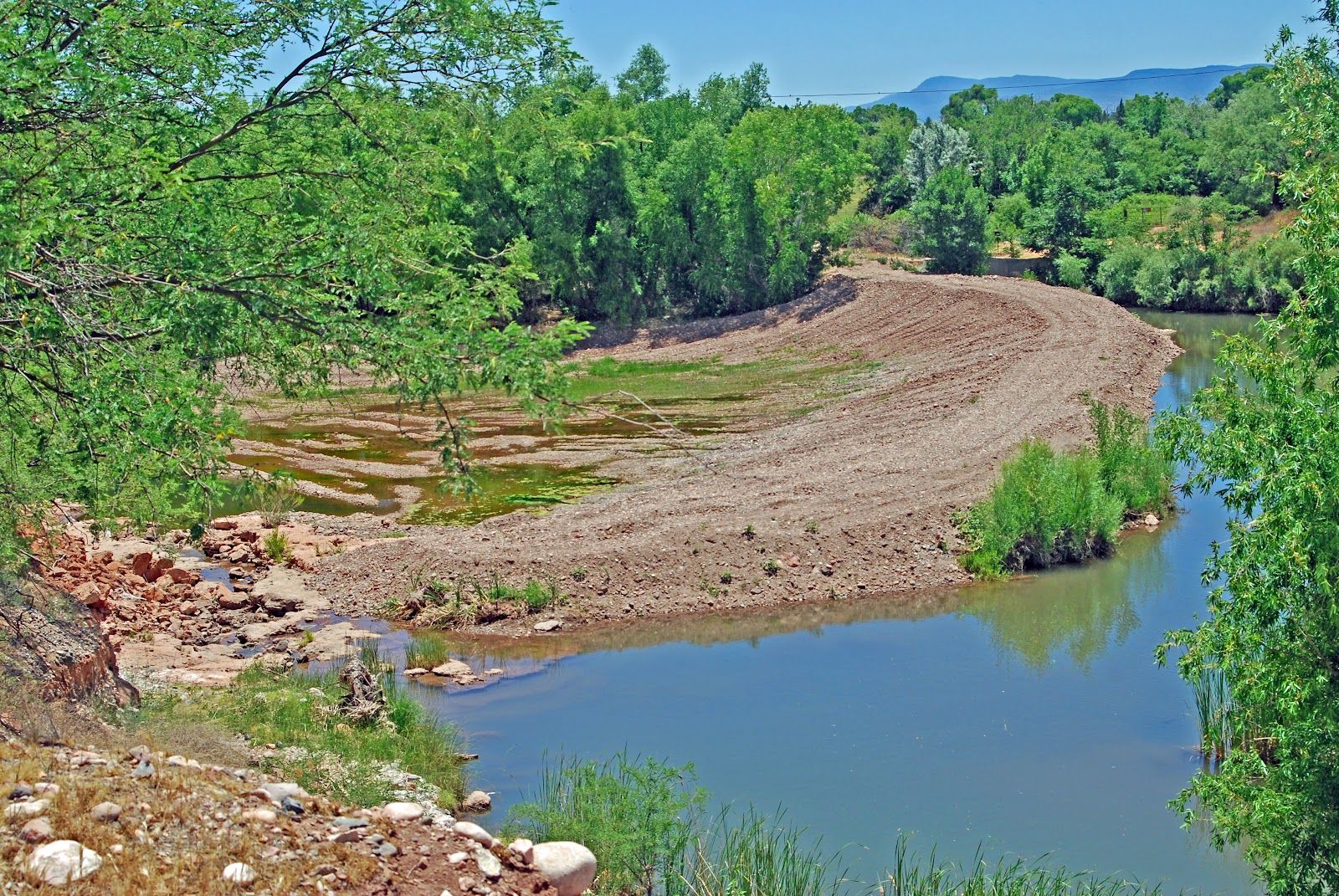
3. The Ugly:  Local rancher, Andy Groseta, has created a gravel diversion dam across the Verde River blocking nearly 99% of the river's flow.  Why? Because he can under "first rights" fill his ditch system and because there's a buck to be made.  It's called greed . . . at least in some circles and, in others, called stupid.  The river always wins!
2011 version of Cottonwood Diversion Dam
2013 version of Cottonwood Diversion Dam. Photo: Bill Regner.


Sunday, December 23, 2012

An Ignorant Attitude

The use of water for many in the Southwest elicits a head in the sand, nearly schizophrenic, reaction from some people.   In the face of naturally occurring water scarcity aggravated by global warming [see Krugman comment, below] there is sentiment that all sectors of the environment are the same.
. The facts, however, bring us back to reality.
The Verde River has toxic waste emptied 
into it at many points along its flow through 
Arizona.
Living conditions in the desert are different than the conditions of living in the Midwest. Concessions must be made for a desert environment where precipitation is below 12 in. per year, water resources that are being over-used, and struggling with a high component of toxic waste.
As a point of reference, the Ogalalla Aquifer in the Midwest forces water upward to within 2 ft. of the surface. It is one of the key reasons for the veto of the Keystone Pipeline and a resource that distinguishes the Midwest environment from that of the Southwest.

A common response from residents of Arizona :

"Yikes! Thanks for speaking up on this, Katie! Just the idea of looking at water as a COMMODITY scares the beejeezus out of me... and i agree, taxing the shit out of those of us who have gardens just seems so wrong. I agree that wasting water is bad, and i try to collect rainwater to water my garden, but for fruit trees and other trees, there's usually not enough. This is a huge issue. Clarkdale doesn't want anybody to water anything so they can continue to grow their population...."


In other words, "C'mon, guys, all I want are a few fruit trees. It's not so bad...I use rainwater for my other plants."

The presence of rivers often gives people the idea that
water is plentiful.
Our "Yikes!" comment continues. . . for "those who can afford to continue watering, the price of water won't matter. So once again, the poorer will suffer... the rich will have their lawns and pools, the poor will be robbed of growing decent food. And yes, there are just too damn many people already for sustainability."

In the column, "This Tribal Nation," by Paul Krugman in the NY Times:". . .having a college degree didn’t appear to make one any more open to what scientists have to say (on global warming). On the contrary, better-educated were more skeptical of modern climate science than their less educated brethren."

Water issues are not social issues, hobby farms and ranches excluded. The availability of water for non-essential uses simply subtracts from the amount that will be available for essential ones in the future.

Monday, June 25, 2012

Has the Aquifer Run Dry?

In a recent news note in the VerdeNews.com, Tom Whitmer of Cottonwood, Arizona, had been nominated for a position on the Technical Advisory Committee with the Yavapai County Water Advisory Committee.

Photos taken from verdenews.com
His nomination was questioned by Doug Von Gaussig because Mr. Whitmer serves on the board of that organization and the conflict of interest was all too apparent . . . especially with respect to an appointee who would, in effect, report to himself.


I congratulate Mr Von Gaussig whose foresight has otherwise addressed many of his communities difficult problems.


I would like to see either principal in this local scuffle, begin to answer Jerome, Arizona's, water difficulties.
  
Here in this ex-mining, tourist town we drink from an aquifer via a couple of large storage tanks.  But the overflow from these tanks has stopped...which means that 1.) the tanks aren't full or 2.) the aquifer has stopped charging the tanks. 


We've had little rain, the Verde River is at record lows and a Jerome town council member is talking about the installation of water meters.  What if there just ain't any water?

Tuesday, August 30, 2011

Selling the Verde River, Part 2

It seems that any thoughts expressed about the Arizona ditch system that draws water from the Verde River generates a variety of knee-jerk reactions that are inaccurate or irrelevant.

The point made in the previous post was that the design of the diversion dam on the Verde River may be pushing more water through the Cottonwood Ditch than it is entitled to take.

I did not (1.) condemn the ditch system nor did I (2.) disparage the 300+ users of Cottonwood Ditch water.  Although certainly possible, I did not (3.) question the environmental impact of the diversion dam.
Google Earth Image taken June 13, 2011, showing the Cottonwood Ditch Assoc. diversion dam.  Nearly 100% of the Verde River is blocked, diverting most of the river’s flow not along its natural course but to the Cottonwood Ditch. Various springs and seeps restore the river’s flow about 1,000 yds. downstream.

Others have concerns, as well. 
Doug Van Gausig, Mayor of Clarkdale, entered comments into the minutes of the town council meeting of June 2007 regarding Mr. Grosetas activity.

"This summer the Cottonwood Ditch is again diverting 100% of the Verde River into their ditch, allowing only a trickle to bypass the diversion. This is a terrible thing for the river's habitat. It means that the river is no longer a viable corridor for transportation and migration of aquatic animals - the diversion becomes, in essence, an unnatural barrier to movements in the river. I talked to Greg Kornrumph, of SRP, and to Max Castillo and Les Bovee of State Parks (which operates the Hickey Ditch) about possible remedies for this situation. I'll continue to work on this issue with State Parks, FreeportMcMoRan and Cottonwood Ditch to find an equitable, legal and durable solution to this annual problem."

A suggestion made by Mr. Groseta is that “interested citizens and political leaders consider the adverse impact . . . trees and vegetation are causing to our river system. These millions of trees are sucking the river dry!", he asserts. 

If this is the case, it’s surprising he has let trees and vegetation line the first mile or so of the Cottonwood Ditch.  (He is President, remember!!!)

As the photo indicates, the river's water has disappeared because of the dam, not because of surrounding trees and vegetation.

Mr. Groseta's myopia may stem from all the trees that block his view of the forest.

The question should not be my qualifications but Andy Groseta's take from the river.  It affects everyone.


NOTES: 
1. I debated whether to continue the subject of this blog in the Verde Independent.  A newspaper is not the format for on-going discussions of a subject.

2. Some respondents to my previous blog should learn the difference between insinuation and inference.  I don't insinuate anything, but I can't control reader inferences.


Tuesday, August 2, 2011

How to Sell the Verde River.

Andy Groseta has again blocked the complete flow of the Verde River.  He's entitled to do it...Arizona law says so.  The law also says he is entitled to take 10.6 cubic-feet-per-second from the river for the Cottonwood Ditch Association, an organization he heads up.
Note the increased level of the Verde River upstream from the dam and note
the curved configuration. That's important because it increases the flow rate of
water through the sluice gate that is a primitive way of measuring his
"take" ...which he sells.
His water-take is determined by a simple sluice gate.  The flow through that sluice gate, however, is determined by the pressure of the river, whether the river is "high" or "low".

Note the level of the Verde behind the dam.  It's 8 -10 feet higher than downstream.

The primitive measuring systems in use do not calculate river back-up, water pressure and subsequent flow.  

It's not the diversion dam that's at issue.  The issue is whether the design of the diversion dam increases his "take" beyond his entitlement.


Has anyone measured Groseta’s take from the river?

My neighbor has a sign that proclaims, “The River Always Wins.”

We’ll see.  The Verde may need some $$$s of its own.

Sunday, May 23, 2010

Arizona Boggles on River Definition…Ownership

I carefully tore out Steve Ayers’ article, “Verde ownership status still on hold”, from a recent issue of the Verde Independent  and have read and re-read the piece a dozen times or more.


Attorneys are the only ones who seemingly understand the questions of ownership of the Verde River and courts keep passing the issue up, down, and sideways.

The basic question, courts are asking, is whether the Verde River was “navigable” in 1912 when Arizona became a state.

Navigable is the operative word.

The impact of the answer is two-pronged.
  1. If navigable, the State owns the Verde River and it is public.
  2. If it wasn’t navigable, adjacent property owners own the Verde and it is private.
Questions are legion.

Does Arizona legally define rivers as having to be “navigable”?

What is “navigable”…?
      Navigable to an inner tube?
      Navigable to a river boat drawing 1 – 2 ft. of water?
      Navigable to an inflatable raft?
      Navigable to a swimmer?

What is in the best interest of the State?

What is in the best interest of the people of Arizona?

Is it in the best interest of the State to let ownership fall to property owners of the region who would “own” the water and divert it to a ditch system to sell to various interests?

Whatever the questions…Whatever the speculations…The river will win.  Attach sufficient legal handles, manipulate it through the courts, “handle” it enough, and…it will fool you. 

Rivers can be fickle.  Maybe…just maybe, it will dry up and call itself a dry wash.  

Thursday, October 29, 2009

Looking Out My Back Door

With apologies to CCR…

Currently there is talk in Arizona about sustained safe-use of water resources. Proposals are offered, solutions returned.  Most are merely hopeful, some just ridiculous.

If you want to know what the desert will naturally support, just look out your back door.  For a personal experience, pack into a wilderness area. Sycamore and Loy canyons are close. Legs of your trip will have to be planned carefully between springs, stock tanks, water holes. 

The desert doesn’t support an abundance of wildlife (human or otherwise) and the density of animal populations is typically low. In Arizona, for example, density of the deer population is estimated at 10 per sq. mi. -- in the most favorable habitat -- while in Wisconsin that number ranges from a high of 100 per sq mi. to an average for the state of 25 – 35 per sq. mi. 

Vegetation is scattered, also.  Monocultures such as lawns, vineyards and cotton farms don’t exist naturally because the water necessary to support them doesn’t exist.

Running counter to the scaled-back density of animals and vegetation, human population in Arizona has increased approximately 26% in the last in the last eight years.

The desert will not naturally support megaplexes like Phoenix or Tuscan with their monocultures of people. It is not an Iowa cornfield.

When we talk about pumping aquifers, constructing diversion dams and establishing reservoirs to support non-native agriculture and an overgrown population, it’s a conversation about debt…water debt.

Two water resources are particularly misleading:
1. Reservoirs, scattered about Arizona, look like lakes but are nothing but rivers with an enlarged surface area (and greater than normal evaporation) and. . .
2. Aquifers, being hidden, are only remotely connected to people’s awareness.

The perfect storm? . . .maybe it’s your choice. . . pump the rivers and aquifers and. . .take your chances.

For more on this subject please see   http://verdenews.com/main.asp?SectionID=109&subsectionID=1079&articleID=33135

Friday, August 21, 2009

When the River Becomes a Swamp -- Part 2


Idyllic, isn't it?


The Verde River is high...ducks, blue herons, kingfishers and other wildlife "use" its braided path all the way to the Salt River far to the South.  

People. . . also. . .use the river and that's where trouble begins. Some use it for pleasure, others for commerce.  Some more wisely than others.

One of the more perceptive observers is Doug Von Gausig, the mayor of Clarkdale, Arizona.  Maybe a birder, he's certainly observant. Von Gausig has seen 175 species of birds on his property in the 7 years he’s been here.

Talking to "High Country News" in 2007, Von Gausig said, "...the Verde is more than bird habitat. The river is a touchstone for people who live near it...a place to spend time in, something beautiful, something that brings peace to their lives. (High Country News, "Battle for the Verde", May 14, 2007).


Today that sentiment may no longer be viable.  The river has changed.


Writing in the August 2009 Issue of The Noise, a monthly entertainment tabloid published in northern Arizona, Ellen Jo Roberts laments her aborted rafting trip on the Verde: "It's not an easy river"..."We never made it to (our destination)"..."Our plan was foiled by one portage too many...leaving us all sliced up with green reeds and weeds as sharp as paper cuts."


She explains, "...the river wasn't moving much...to get anywhere we had to vigorously kick...or risk circling in the same spot all day."


Although it likely wasn't within the article's scope, she fails to pose a simple question, "Why...?, Why doesn't  the river flow?"  That's what rivers do.


The answer lies with commercial interests and the fact that no consideration of the Verde River is complete without mention of diversion dams and the dams' affect on the environmental qualities of the river.


Questions are easy...solutions are complex and tangled in antiquated Arizona water laws.


Let's try the easy way . . .
  • Diversion dams serve agricultural interests.  With limited supplies of water in Arizona, why are some land owners determined to grow what the environment won't support naturally?
  • If commercial interests are at stake, what ethic permits these interests to take primacy over personal enjoyment?
  • If water ownership is primal, does that owner have the right to take water until the very river is destroyed?
  • Do water rights effectively mean river ownership?
High above the Verde River are the remains of the Anasazi dwelling, Tuzigoot.  Inhabited from about 1125 - 1400 AD, these ancients knew enough, even with water control structures of their own, not to destroy the river.  


Tuesday, August 11, 2009

When the River Becomes a Swamp -- Part 1


Guide books refer to the Verde River as one of the last free flowing, perennial streams in Arizona.

Maybe it was free flowing years ago, but not today.


There are many causes--drought, lack of snow pack, depleted aquifer--but foremost is the Cottonwood Ditch Association in Cottonwood, Arizona.

The Cottonwood Ditch Association (CDA) constructs "diversion" dams across the river, channeling the river's flow into irrigation ditches that serve the interests of a few hay and alfalfa farmers...local suppliers to cattle ranchers and horsemen. Often these groups are one and the same.

The one who manages these operations is Andy Groseta, President of the CDA, on one hand, and chairman of the National Cattlemens Beef Association Policy Division, on the other.

While visibility of this issue has been minimal and controversy nonexistent, it has raised interest (and possibly the hackles) of at least one adjoining community.


Speaking to City Council on June 12, 2007, Clarkdale Mayor Doug Von Gausig remarked, "...I think it's important to know what's going on with this issue. I met with Andy Groseta, ditch boss of the Cottonwood Ditch Association. This summer the


Cottonwood Ditch is again diverting 100% of the Verde River into their ditch, allowing only a trickle to bypass the diversion. This is a terrible thing for the river's habitat. It means that the river is no longer a viable corridor for transportation and migration of aquatic animals - the diversion becomes, in essence, an unnatural barrier to movements in the river."

That was June, 2007.

Fast forward to August, 2009...and...nothing has changed. On my last trip to the Verde the flow of the river was virtually stopped and, again, 100% of the flow was diverted to the ditch system.

The effect on the river has been dramatic: the river had been changed to a slough, the flow was nonexistent, willow variants had


grown 15 ft high and 20 ft out from the banks, cattails were growing mid-stream and thick clumps of algae had formed in open areas.
Coming from the Midwest, adjacent to lakes Michigan and Erie, it's hard to imagine that one man/organization can control what is ostensibly a public body of water.

The irony in this case is that he's working at cross purposes with the City of Cottonwood (where he lives) and is at odds with the interests he represents. The river, as he knows it, will likely disappear depriving him of his irrigation source.

Additionally, in May of this year, the city paid a consulting firm, ESI Corp., to come up with a Strategic Economic Development Plan, Focus on Success.

The Plan cited the Verde River as one of the assets the town ought to promote:
"The first strategy is to develop river access points and multi-use trails leading from Old Town and other areas in town to the river. This will increase connectivity between the river and amenities in Old Town Cottonwood, and will thus encourage additional tourists to visit one of the main attractions in the City: the Verde River."

But...

What happens when the River becomes a swamp?
What happens when that swamp serves as a breeding ground for mosquitos?
What happens when tourists carry home various illnesses as souveniers of their trip?
What happens when the river will no longer supply the irrigation interests of a few land owners?

Andy Groseta and the Cottonwood Ditch Association is working counter to its own interests. They will find this out when the River has chosen some new options or has found another way around the Ditch Association.