Showing posts with label water management. Show all posts

Saturday, November 24, 2012

When Major Rivers Run Low

from the LaCrossTribune.com


The Army Corps of Engineers on Friday began reducing the flow from a Missouri River reservoir, a move expected to worsen low-water conditions on the Mississippi River and potentially bring barge traffic to a halt within weeks.
The Missouri flows into the Mississippi around a bend just north of St. Louis. One result of this year's drought, the worst in decades, has been a big drop in water levels on both rivers.
The corps announced earlier this month that it would reduce the outflow from the Gavins Point Dam near Yankton, S.D., to protect the upper Missouri River basin. That drew an outcry from political leaders and businesses downstream, who warned that allowing the Mississippi to drop more could have devastating economic consequences.
Corps spokeswoman Monique Farmer told The Associated Press on Friday that the reduction began as scheduled that morning. By midday, the flow that had started at 37,500 cubic feet per second had been cut to 35,500 cubic feet per second.
Farmer said plans call for a gradual reduction down to 12,000 cubic feet per second by Dec. 11 because of the drought.


Wednesday, August 22, 2012

Where Water Meets Sun

This photo of a remarkable project in India was recently sent to me by Richard M. Hileman, a Facebook friend who obtained it from Occupy Wall St. It came with his comment, "This would be good for Arizona."

This solar panel laid on the vast stretches of agricultural channels 
in Gujarat India generates 1 Megawatt of electricity per km and 
prevents evaporation of 1 crore (10,000,000) liters of water 
every year.

While it might prove impractical for the mountainous regions of northern Arizona, it would seem a workable solution for clean power generation and water distribution in the southern part of the state which has higher proportion of largely flat land.


The concept would particularly suit irrigation projects and diversion canals which are already level and suffer high levels of water loss due to evaporation.

Monday, February 27, 2012

The Hard Facts

Ahh...the hard facts. They bring us home to reality. 


The hard facts are that conditions of living in the desert are different than the conditions of living in the Midwest.  Concessions must be made for an unusual environment, an environment  that has little water, water resources that are being over-used.


As a point of reference, the Ogalalla Aquifer in the Midwest forces water upward to within 2 ft. of the surface.  It is one of the key reasons for the veto of the Keystone Pipeline and a resource that distinguishes the Midwest environment from that of the Southwest. 


A common response from residents of Arizona or otherwise in the Southwest takes the tenor of the following conversation:
Yikes! Thanks for speaking up on this, Katie! Just the idea of looking at water as a COMMODITY scares the beejeezus out of me... and i agree, taxing the shit out of those of us who have gardens just seems so wrong. I agree that wasting water is bad, and i try to collect rainwater to water my garden, but for fruit trees and other trees, there's usually not enough. This is a huge issue. Clarkdale doesn't want anybody to water anything so they can continue to grow their population....
In other words, "C'mon, guys, all I want are a few fruit trees. It's not so bad...I use rainwater for other plants."


From a current column "This Tribal Nation" by Paul Krugman in the NY Times:
". . .  having a college degree didn’t appear to make one any more open to what scientists have to say. On the contrary, better-educated were more skeptical of modern climate science than their less educated brethren."


Our "Yikes!" comment continues. . . for "those who can afford to continue watering, the price of water won't matter. So once again, the poorer will suffer... the rich will have their lawns and pools, the poor will be robbed of growing decent food. And yes, there are just too damn many people already for sustainability."


Water issues are not social issues, hobby farms and ranches excluded.  The availability of water for non-essential uses simply subtracts from the amount that will be needed for essential ones in the future.


Saturday, February 18, 2012

Population Key to Water Use

It strikes me that we can drown in local legislation while the broader solution is directly in front of us: POPULATION.

We like to think we can beat the numbers.  At least commonly accepted ones.  


The density or concentration of desert flora is a fraction of what it is in
the Midwest.


The density or concentration of desert fauna is, also, a fraction of what it
is in the Midwest.

For example, the density of the deer population in Wisconsin is 30 times,
in a favorable habitat, of what it is in Arizona, a arguably more hostile one.


Why the human animal feels confident it can beat the numbers, I don't know.

We are continually drilling deeper to find aquifers and, frankly, the
handwriting is on the wall.


A developer may be able to demonstrate a "100 year assured supply" until a guy
on the adjoining property drills into the same aquifer and halves the capacity
of a viable aquifer.

I don't question that "
Arizona law allows threats to water resources."  I wonder that solutions have not been laid out. 

Thursday, January 26, 2012

Water Must Deal with 25 MM Population Increase


The UA’s Water Resources Research Center held its recent conference to discuss the present and future state of Arizona’s water issues.
Not much new was reported but some obvious views were well taken.  Here is a summary from the DAILYWILDCAT.com.
The conference played with ideas to more effectively use water coming into Arizona. Main issues involved choices people make with the water they already have, how not to continue population growth with the little water they receive and more long-term plans for what to do with their water over the next 40 to 100 years.
Joseph Garcia, director of communications at ASU’s Morrison Institute for Public Policy, said about 70 percent of water in Arizona goes to agriculture. The rest of it goes to industries and mining, recreational urbanization or landscape use.
“We are not running out of water,” Gammage said, “but we can’t do everything forever. We can’t support continued population growth and also support agriculture and also support the environment.”
Arizona is allotted about 2.8 million acre feet per year from the Colorado River. Because Arizona doesn’t currently use all of its allotted water, it ends up being dumped back into the environment, Gammage continued.
"If you believe that leaving water in the environment is a use, which lots of people don’t, then we are using it all."
According to Gammage’s report, the population over the next 40 years will grow by 25 million or more, leading to an increase in water demand to about 5 million acre feet of water per year.

Friday, December 23, 2011

Which Way Goes Desire

When we talk about the availability of water resources, we assume 0.5+ acre foot per person.  
As people f.... and population increases, the question for Arizona is whether our sexual desire will overcome our thirst. 
That's an interesting question. 
The disturbing complexity is that thirst will kill us and sex, or the lack of it, will make life unpleasant.  
There's a finite limit to Arizona's water...a finite limit to population hasn't been found.
If you need it spelled out, a growing population will have effects on water use.
You can pick up sex at the local grocery store.  Wanna quible about water? 

Sunday, October 23, 2011

Environment and Jobs


In a recent column titled, “Party of Pollution”, Paul Krugman writing in the October 20, 2011, NY Times remarks that current thought among some Republicans wants environmental laws defanged for the ostensible purpose of creating jobs.
 
Krugman, concludes that suspending or eliminating environmental laws will simply make us sicker and poorer.

In a coincidental presentation to the Cottonwood City Council, Andy Groseta, head of the Arizona Cattle Growers Association, took a cue from some of the positions of Republican presidential candidates and initiated an attack on the National Environment Policy Act (NEPA) calling for a five-year moratorium on legal challenges under the Act. He singled out federal environmental regulations as standing in the path of the Arizona Cattle Growers Association plans to place thousands of cows in the federal forests. 

Without cattle eating more of the government grass, he says, calamitous fires will continue to ravage the Southwest and future famine was imminent. He claimed, also, his plan opens up the prospect of future jobs. 

"We need a 'time out' from the environmental process to harvest more trees and get more cattle out there," he said.
 
He called the measure a "jobs creator bill."

Job creation, as a concept, has become the new enabler.  Despite the temporary change created in the name of jobs, longer lasting effects will affect the environment, rivers and water resources in particular.

Without trees and grass rain impacts the ground directly and in this hilly region of the Southwest run-off, or just simple erosion, becomes a problem.  Run-off loads rivers with silt as topsoil is washed away.

Clear cutting was implicit.  Selective cutting of trees to clean out years of undergrowth and neglect was not mentioned. 


In this desert environment trees such as Douglas Fir and Ponderosa Pine take decades to mature. 

A moratorium on EPA Regulations is, in effect, a permanent solution in the desert.  

In contrast, for example, trees in the Northwest reach harvestable size in 15 years because of the abundant rainfall.  Cottonwood, Clarkdale, and Jerome don’t get abundant rainfall.  

Obviously, we all have a stake in this public position and ranchers should not hold a special position that alters our water resources because of queer, uneducated, special interests.

Our water resources are more important than Arizona Cattle Growers Association interests.

Monday, September 19, 2011

Water Use Threatens Colorado River & Arizona


On a particularly frightening note, a Climate Central article written July 13, 2011, by Tom Yulsman (climatecentral.org), pointed out that for the first time withdrawals from the Colorado River outpaced supply and future water consumption is likely to continue this desperate trend.

The Colorado River supplies water to almost 35 million people in 7 states including Arizona.  The shortfall has been made up through increasing draws from Glen Canyon and Mead Reservoirs.  The reservoirs, however, are having problems of their own.  Facing a “worst case scenario” the reservoirs are going through an 11 year drought, the worst in recorded history.


This shortfall is occurring despite a snowpack of huge proportions this year in the Colorado Rockies which is the primary supplier to the river.


It’s also occurring in the face of decreased per capita use in the Colorado Basin.  In a study measuring use over 20 years it found that while the per capita use dropped a whopping 20% … the total people using water from the Colorado River grew by 10 million. 


As their study concludes, this is unsustainable.

Tuesday, August 30, 2011

Selling the Verde River, Part 2

It seems that any thoughts expressed about the Arizona ditch system that draws water from the Verde River generates a variety of knee-jerk reactions that are inaccurate or irrelevant.

The point made in the previous post was that the design of the diversion dam on the Verde River may be pushing more water through the Cottonwood Ditch than it is entitled to take.

I did not (1.) condemn the ditch system nor did I (2.) disparage the 300+ users of Cottonwood Ditch water.  Although certainly possible, I did not (3.) question the environmental impact of the diversion dam.
Google Earth Image taken June 13, 2011, showing the Cottonwood Ditch Assoc. diversion dam.  Nearly 100% of the Verde River is blocked, diverting most of the river’s flow not along its natural course but to the Cottonwood Ditch. Various springs and seeps restore the river’s flow about 1,000 yds. downstream.

Others have concerns, as well. 
Doug Van Gausig, Mayor of Clarkdale, entered comments into the minutes of the town council meeting of June 2007 regarding Mr. Grosetas activity.

"This summer the Cottonwood Ditch is again diverting 100% of the Verde River into their ditch, allowing only a trickle to bypass the diversion. This is a terrible thing for the river's habitat. It means that the river is no longer a viable corridor for transportation and migration of aquatic animals - the diversion becomes, in essence, an unnatural barrier to movements in the river. I talked to Greg Kornrumph, of SRP, and to Max Castillo and Les Bovee of State Parks (which operates the Hickey Ditch) about possible remedies for this situation. I'll continue to work on this issue with State Parks, FreeportMcMoRan and Cottonwood Ditch to find an equitable, legal and durable solution to this annual problem."

A suggestion made by Mr. Groseta is that “interested citizens and political leaders consider the adverse impact . . . trees and vegetation are causing to our river system. These millions of trees are sucking the river dry!", he asserts. 

If this is the case, it’s surprising he has let trees and vegetation line the first mile or so of the Cottonwood Ditch.  (He is President, remember!!!)

As the photo indicates, the river's water has disappeared because of the dam, not because of surrounding trees and vegetation.

Mr. Groseta's myopia may stem from all the trees that block his view of the forest.

The question should not be my qualifications but Andy Groseta's take from the river.  It affects everyone.


NOTES: 
1. I debated whether to continue the subject of this blog in the Verde Independent.  A newspaper is not the format for on-going discussions of a subject.

2. Some respondents to my previous blog should learn the difference between insinuation and inference.  I don't insinuate anything, but I can't control reader inferences.


Tuesday, August 2, 2011

How to Sell the Verde River.

Andy Groseta has again blocked the complete flow of the Verde River.  He's entitled to do it...Arizona law says so.  The law also says he is entitled to take 10.6 cubic-feet-per-second from the river for the Cottonwood Ditch Association, an organization he heads up.
Note the increased level of the Verde River upstream from the dam and note
the curved configuration. That's important because it increases the flow rate of
water through the sluice gate that is a primitive way of measuring his
"take" ...which he sells.
His water-take is determined by a simple sluice gate.  The flow through that sluice gate, however, is determined by the pressure of the river, whether the river is "high" or "low".

Note the level of the Verde behind the dam.  It's 8 -10 feet higher than downstream.

The primitive measuring systems in use do not calculate river back-up, water pressure and subsequent flow.  

It's not the diversion dam that's at issue.  The issue is whether the design of the diversion dam increases his "take" beyond his entitlement.


Has anyone measured Groseta’s take from the river?

My neighbor has a sign that proclaims, “The River Always Wins.”

We’ll see.  The Verde may need some $$$s of its own.

Monday, April 25, 2011

Water Use Slowing but Rates Increase

Water use in at least one Arizona metro area seems to be slowing according to a news item reported several times on KJZZ, an NPR radio station in Tempe, and the Arizona Daily Star in Tucson.  

Despite an increasing population in the Tucson Water Service Area, served by several utilities, water use is only slightly higher than a decade ago.

Use is even less when calculated on a per-person basis.  That number has dropped from 164 to 133 gallons per day since the year 2000.

Reasons for this decline are only speculative but range from the slower economy to residents’ changes in income, household water bills, their attitudes about their financial future, and even their mortgage situation asserts Gary Woodard, an associate director of hydrology and water resources at the University of Arizona.

However, the water utilities want the economics to cut two ways. 

When supply is adequate and demand drops as it has in some communities, prices should decrease . . . at least according to our laws of supply and demand.  Because demand has dropped, the water utilities shouldn't cry poor because of sliding revenues and shouldn't charge higher rates to remedy their problem.

But, that’s exactly what they’re doing by proposing an 8.2% increase for fiscal 2011 – 2012.

The solution, says a friend with former ties to Ohio’s Public Utilities Commission, is to establish a similar organization in Arizona that would regulate rates, not with an eye to profit but what utility rates are necessary to cover costs.

That may be too much to expect short term but what we can count on, long term, is more expensive water.


To review background on this, click on the following link:

Saturday, April 16, 2011

Water Resources and City Economics

The growing risk of water shortages in the Verde Valley and throughout the state of Arizona will have a direct effect on the bond ratings of the cities involved, says an opinion piece in the October 20, 2010, New York Times. 

Snowmelt is regional  and usually doesn't reach the broader environment
While lowered bond ratings are not currently a problem for many communities in this area, it likely could be in the future.

Part of this liability is due to local squabbling for this resource, commonly referred to as “water wars”, and the attendant legal costs that drain municipal budgets.

“Municipal bonds are bought and sold on the basis of their credit ratings,” the NY Times article reminds us, “yet today these ratings take little account of utilities’ vulnerability to increased water competition.”

Pursuing a cautious perspective against future water costs, the city of Cottonwood bought several water companies in surrounding areas and shortly thereafter raised the rates.  In an editorial of August 22, 2010, the Verde Independent characterized this buying as a “spending spree” and suggested the city follow the advice of its financial director, Rudy Rodriguez, to go on a PR offensive “so people understand why the attendant rate hike is necessary and important.”

The Verde Independent is correct that the city should communicate its intentions to its residents.  It's just good politics to tell taxpayers how the city is spending its/their money...and why. 

Rates, by the way, were decreased at the lowest use levels but, none-the-less, raised at higher levels.
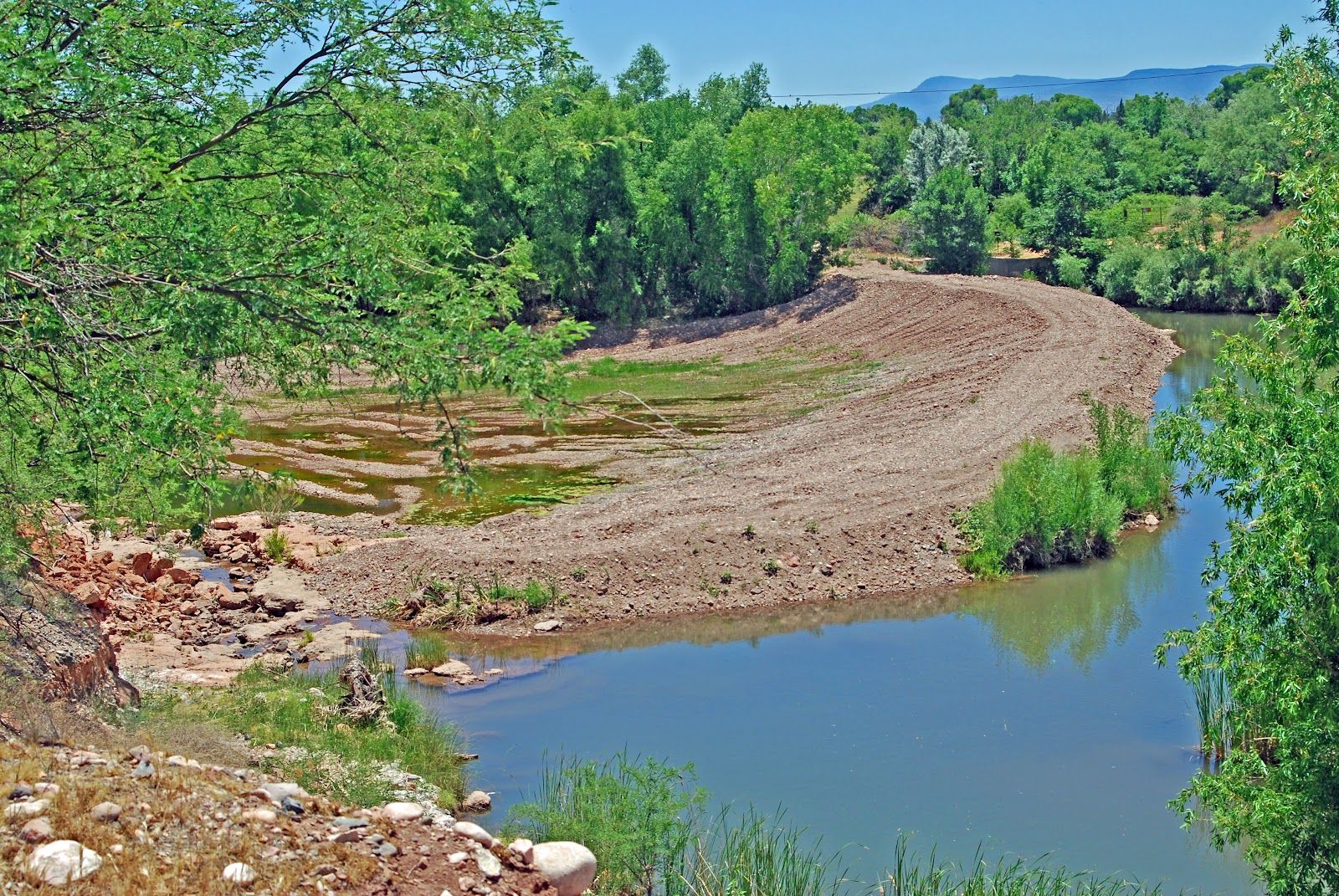
There was a river but vegetation didn't know it.
It seems reasonable to give breaks to “minimal” users and raise rates for large users.  In other words, conservative water users will be charged the same or less than before the rate increase and “excessive” users would be charged at increased rates.

What is essential is that people realize we are living in the desert where water is scarce and finding a path to sustainable use can be complex. . .water is a limited commodity and should be expensive. 

Cottonwood officials realized that water use will be governed by our wallets and it was a far-sighted city administration that intelligently planned for the city’s future.

Of course, the saga of Cottonwood-water has a negative side.  According to a local resident the city is again planning to alter its rates upward because decreased water use has put a dent in anticipated revenue.  
Cliffs, Mesas, Water.

But, the Arizona Republic has another take.  In an April 15, 2011 article focusing on Phoenix, the newspaper wrote, "Residents Should Know Who Is Behind Water-Rate Hikes".  The paper claims the projected increase is due to the State of Arizona withdrawing $7 million in funding from the Arizona Dept. of Water Resources and shifting the burden to cities. The AR pins blame on Gov. Jan Brewer.

In either case the Arizona Republic echoes the Verde Independent in calling for better communication between city administrations and their residents. 

The likelihood is residents won’t like what they hear.  Water is going to be expensive…very expensive. . .and it should be because water in the desert is a scarce commodity. 

Saturday, July 10, 2010

The Cost of Water

It's about time someone began thinking in terms of $$$$
Herb Guenther, director of the Arizona Department of Water Resources, has often said that the era of cheap water in Arizona is over.  It's a wise sentiment, and I think that it's high time the era of cheap water in Arizona was over, but is it really?  Have Arizonan water companies really changed the way they price their water for retail consumption?  Have consumers really changed the way they use it?  We're beginning to make some progress by implementing more increasing block rate structures.  With these rates, as usage hits a specified threshold, the per unit price of water rises for the next block of water usage.
How people can expect the least available commodity in the desert to be one of the least expensive stretches belief.
As prices rise, maybe people will get the idea that maybe, just maybe, water ought to be used more conservatively.
If nothing else, the current recession may drive this point home.


Sunday, May 23, 2010

Arizona Boggles on River Definition…Ownership

I carefully tore out Steve Ayers’ article, “Verde ownership status still on hold”, from a recent issue of the Verde Independent  and have read and re-read the piece a dozen times or more.


Attorneys are the only ones who seemingly understand the questions of ownership of the Verde River and courts keep passing the issue up, down, and sideways.

The basic question, courts are asking, is whether the Verde River was “navigable” in 1912 when Arizona became a state.

Navigable is the operative word.

The impact of the answer is two-pronged.
  1. If navigable, the State owns the Verde River and it is public.
  2. If it wasn’t navigable, adjacent property owners own the Verde and it is private.
Questions are legion.

Does Arizona legally define rivers as having to be “navigable”?

What is “navigable”…?
      Navigable to an inner tube?
      Navigable to a river boat drawing 1 – 2 ft. of water?
      Navigable to an inflatable raft?
      Navigable to a swimmer?

What is in the best interest of the State?

What is in the best interest of the people of Arizona?

Is it in the best interest of the State to let ownership fall to property owners of the region who would “own” the water and divert it to a ditch system to sell to various interests?

Whatever the questions…Whatever the speculations…The river will win.  Attach sufficient legal handles, manipulate it through the courts, “handle” it enough, and…it will fool you. 

Rivers can be fickle.  Maybe…just maybe, it will dry up and call itself a dry wash.  

Wednesday, February 3, 2010

Socialized Water Resources

Owning water resources in the desert is a novel idea, especially moving water such as rivers and streams.

The fact that litigation regarding various water "rights" has been stalled in Arizona courts for decades might lead anyone to the conclusion that water can't really be owned. . .at least not comfortably. . . and not in the sense that Arizona law seems to dictate.

The law is currently based on a "first use" concept.

Unfortunately, water is valuable in the Southwest because of its scarcity and attracts people who would try to own it -- and sell it.

What emerges is a suspicion that water, like the air, is a public commodity...that water may belong to everyone and should be handled that way.

If water is privately owned, on the other hand, the delivery of it is accomplished for a profit motive, not from the perspective that it is a resource necessary for living. Money is the motivator, at least on the supply side.

The current concept stretches the credulity of private ownership. I'd suggest, as an alternative, that all water resources be governed by a Public Utilities Commission that sets rates for consumers. And profit levels for suppliers.

What does a Public Utilities Commission do? It governs the utilities that gather, purify, treat, and deliver water to its customers. At least in that way water resources would be in a public trust and administrators would handle it for the public good.

Does this mean socialized water?

Of course...and, with "public" ownership comes equal distribution of the resource itself. If it belongs to everyone, a water resource manager could ensure that it is distributed more or less equally around the state.

That Water Resource Manager might operate from a measurable inventory of water resources or, at minimum, a rough idea of how much water exists. . . at least surface water.

There might be two provisos; 1. The resource not be irreparably depleted by use, and 2. Upstream uses not reduce downstream availability.

There could be a per capita allocation and possibly a cap-and-trade system for those who have wells.

Per capita? density limits? Look out your backdoor. The desert sets density limits of its own...and the limits aren't generous.


See also: http://www.verdevalleynews.com/main.asp?SectionID=109&SubSectionID=1079&ArticleID=34886&TM=1900.609

Thursday, January 28, 2010

This Is the Way It Used To Be


Northern Arizona has been paralyzed by rain and snow for several days.  Driving is treacherous through the hills and banked hair-pins of the roads and mountains.

My neighbor, Katie, remarked with a smile and obvious enthusiasm,  “This is the way it used to be.”  Katie Lee is 90 yrs old and has been out here for 50 years. 

Her perspective is invaluable either as an environmental commentator or harbinger of things to come.  Precipitation is at record or near-yearly record levels in this area, but her thoughts should give us pause.

Ought we to think of our soggy environment as temporal or should we think that this variable desert environment will settle back to its usual drought conditions? 

In simple terms, is this the way it will be or should we suspect that the snow plows will soon no longer have reason to cruise the roads?

Can we trust that our water glasses will fill in the future? I’m betting that the conditions that formed the gullies and arroyos we see today as dry, will remain dry in the future.  I think Katie does, also.

Wednesday, January 13, 2010

Adapt or Perish


Often public reporting of water resources in Arizona carries mixed messages.  Reports will point out the shortfall in Colorado River water for the Northern part of the state and yet, at the same, report that mountain snowpack affecting the southern and central parts of the state is above average and the state is doing well.

An article outlining Arizona water use in the Arizona Daily Star, January 10, 2010, pointed out that snowmelt was going through a shortfall in the north but “use”, on the other hand, was remaining constant...or increasing. 

Variable water supply, however, is a way of life in the desert…depending on mountain snowmelt, precipitation, effects of climate change (man-made or naturally cyclical), or any other vagary of nature.

“…extra-dry years balance extra-wet years,” said Brenda Alcorn, a senior hydrologist for the federal Colorado River Basin Forecast Center in Salt Lake City.

"In 1998, the January forecast was 20 percent too low, and in 2006 the forecast was 60 percent too high," Alcorn said.

But what isn’t said is that these are numerical averages that have nothing to do with everyday, average use.  You don’t fill your drinking glass – or swimming pool in Phoenix – with numerical averages.

One gets a hint of this variability by looking at the plants that have adapted to this environment over millennia.

The ubiquitous prickly pear cactus is a good example. If water is “short” the prickly pear will contract.  Its leaves have evolved as spines to minimize water loss and the pad – or stem – expands or contracts to adapt to the environment. 

The water requirements of people, on the other hand, seem to remain constant or simply increase with population growth…they believe the numerical averages…and while supply is highly variable, people haven’t learned in this environment that our lives must adapt to a certain element of variability.

Where I’d suggest we look for an answer is the natural environment…the requirements of “lean necessity” in the desert.  If we continue to over-draft our system, like the prickly pear, we’ll have to begin to contract.

In harsh terms, it’s a choice of adapt or perish. 

See also:  http://verdenews.com/main.asp?SectionID=109&SubSectionID=1079&ArticleID=34556&TM=41836.41

Saturday, January 2, 2010

Who Owns the Water?

Several weeks back I wrote . . .

1. Should water be privately owned and should ownership be couched in terms of “rights” by special interest groups or corporate entities?  Stated differently, is water a public commodity to be held in trust by the state and dispensed equitably for the common good – or – is it owned, as is a mineral deposit, and mined for personal gain? 

2. Should water utilities be governed by a Public Utilities Commission that sets rates for consumers?  And profit levels for suppliers?

3. Would the irrigation used to supply plants be better spent in the Southwest by supplying people?  Not a foolish question.  Looked at differently, if you were packing in the back country with a few liters of water would you consume the limited water you had or would you feed the nearest mesquite tree?

What emerges from these questions is a suspicion that water is, like the air, a public commodity…that water may belong to everyone and should be handled that way.

“You know that song,” says Wendy Wierich in her blog, naturenuts.com, This Land Is Your Land?  “I got to thinking the other day about the vast natural resources that exist in the United States…”

“Here’s the question”, she continues, “How is it that individuals can get rich from national natural treasures?”

“If ‘it is our land’, we should get to decide what happens” she points out.  “If the government owned the natural resources, we could put the profits in a fund to pay for education, health care, retirement, social services for everybody. Everybody.”

“Instead a very few fat cats get fatter and the poor get poorer. We could all benefit from the intelligent mining of public natural resources. As it is, and as it will be, only a few will get the goodies.”

I don’t like the rhetoric nor do I agree with the sentimental approach.  And, by the way, she really should have cited Woody Guthrie if she was gonna use his words.  But, there is a kernel of truth here.

Maybe I get away from the point…who owns the water?...we’ll approach -- perhaps answer --  that question, next.


See also, http://verdenews.com/main.asp?SectionID=109&SubSectionID=1079&ArticleID=34282

Friday, January 1, 2010

Some Basics About Water

Recently, I spent hours reading comments to an excellent article, "Tighter, costlier water shifting focus to curbing demand" by Shaun McKinnon in the Dec. 27, 2009 edition of the Arizona Republic.
  
It became obvious most of the commentators knew little about water or how it interacts with our environment.


Some basics....
1. Water can neither be created nor destroyed.
2. The state of water can be changed and it can exist as a liquid, vapor, or frozen (as snow or ice).
3. Water, as we are accustomed to seeing it, can be unavailable for use.
4. A somewhat reliable statistic is that 0.6% of water on earth is available for drinking.
5. Most importantly, it may take decades or centuries for surface water to trickle 400ft - 500ft or deeper to aquifers.


Taken singly or collectively, these facts should make us question  the practice of (a) pumping aquifers or (b) the validity of terms such as "assured safe yield", "sustainable use", or "assured 100 year supply."


Water for the West comes from the snow pack of the Sierra Mountains or the western slope of the Rockies.  If anyone can characterize this snow pack as "assured" or "sustainable", I'll buy a 100 yr pass to Aspen or Crested Butte.


Thursday, December 10, 2009

Water and My Neighbor, Jerry

Water has many uses…the primary one could be reuse.

My neighbor, Jerry, had placed a 5 gallon bucket under a leaky rain gutter. He didn’t want drips to stain his wood deck. The pail was full and, instead of throwing it over the 4 ½ ft. railing, it was simpler to walk 20 feet and pour it into a planter at the front of his house.

If anything, Jerry’s practical. All of which brings me to the point – water reuse. It sounds simple. In the initial stages of the process, it is.

Jerry could just as easily have tossed snow from his sidewalk into the planter or, local laws permitting, re-directed water from his shower drain to another planter in his yard… Greywater, as it’s called, distinct from water from sanitary lines, can be used in innumerable ways from the garden to washing a car.

According to Arizona guidelines, greywater may be obtained from a clothes washer, bathtub, shower or sink, but not from a kitchen sink, dishwasher or toilet.

A brochure titled, “Using Greywater at Home” outlines many uses and procedures and may be obtained from nro@azdeq.gov

Although not codified into law, the guidelines carry a valuable list of do’s and don’ts when working with secondary water sources including where and when it can be used safely. You can’t take water from your toilet and throw it outside nor do you want to use it on certain plants.

But, it’s inexpensive…and because you’ve already paid for it, you might as well use it again.

Writing in the Santa Barbara (California) Independent, Ben Preston, staff reporter, points out, “It also requires that homeowners, if they weren't already doing so, use biodegradable laundry soap, as traditional soaps would harm the plants. ‘As long as you're using the right products, greywater irrigation makes a lot of sense,’” says Laura Allen, Oakland, California, and a member of California-based Greywater Action. “She has been using greywater on her kiwi and apricot trees and berry bushes for a decade,” reports the Santa Barbara Independent.

Preston continues, “Already in place in Arizona, New Mexico, Texas, Montana, Nevada and other Western states, standards spelling out how best to use water were also passed by the California Building Standards Commission on Aug. 4…”

I’ll order a brochure for Jerry. He really doesn’t have enough to do in his retirement with several antique cars and a business.

Me?...I’ve got no yard.